.jpg)
Demographics, infrastructure, technology and property costs all influence investment attractiveness
To assess where in Europe we see the strongest investment opportunities for port logistics, Savills Research has developed the European Port Logistics Opportunity Index (EPLOI). The index measures the 15 busiest container ports in Europe and draws upon property metrics (logistics rental growth, vacancy rate), demographics metrics (minimum wage, population growth and retail sales growth forecasts, trade growth, ease of doing business) and infrastructure metrics (railway performance index, size and growth of container port capacity, motorway length per capita) to identify emerging trade routes and the strongest opportunities for logistics investment around Europe.
Demographics
Availability of cheap warehouse labour is one of the key determinants of expansion for logistics operators. Migration flows across Europe, attracted by higher wages due to a shortage of labour in developed Western European markets, such as the Netherlands and Belgium. Ukrainian and increasingly, Nepalese workers are now working in Polish warehouses on short-term contracts, filling the void left by those workers who have already migrated west. Over the next five years, the Netherlands (+0.46% pa), Belgium (+0.36% pa) and the UK (+0.34% pa) are expected to witness the fastest population growth, whilst Greece (-0.38% pa), Portugal (-0.28% pa) and Italy (-0.18 % pa) are forecast to see population decline.
Global populism and rising protectionism have posed a threat to growth prospects in recent years. However, according to OECD, Poland (+4.3% pa) and Greece (+3.6% pa) are forecast to witness the highest rates of international trade growth between 2020-21, which will increase container throughput in Gdańsk and Piraeus. UK international trade is expected to grow only 1.2% pa during this time, the lowest in Europe.
Ports add an additional phase in the supply chain of goods. Once containers are unloaded at the ports, they are either carried by freight train/inland barge or HGVs to distribution centres/city ports. From here, the goods are relocated to a regional distribution centre, before moving to either a last-mile centre (for end-user delivery), or directly to shops (see below).
The UK has traditionally been a net importer of goods, and therefore once goods are offloaded at ports, they are transported to warehouses in the “Golden Triangle” at the centre of the country, where 90% of the UK population is accessible within a four hour drive. However, we are now seeing port operators develop warehouses outside the Golden Triangle in order to service both the national and local markets. DP World London Gateway is a good example, being the UK’s fastest growing deep sea container terminal. State of the art facilities paired with excellent connectivity to the UK via both rail and road infrastructure, along with the largest consumer markets in Western Europe allow operational efficiencies to be maximised. Consequently, there has been an uptick in occupiers seeking to acquire warehouse space in the London Gateway Logistics Park.
In mainland Europe, however, a higher proportion of goods are exported, which makes occupying warehouse space in close proximity to the ports of higher importance. EU laws indicate heavy goods vehicle (HGV) drivers must have a 45 minute break every 4.5 hours of driving. Supply chain managers therefore require prime logistics facilities to be in close proximity to established ports to minimise travel time for export goods.
Property
Warehouse costs are only a small fraction of the total costs for logistics operators. Piraeus has witnessed the strongest logistics prime rental growth over the past three years of c.20%, whilst Barcelona (14%), Valencia (13%) and Le Havre (13%) also enjoyed growth in this period. Vacancy rates across the markets are also low with Valencia (2.4%) and Barcelona (3.2%) representing the most undersupplied markets.
Infrastructure, Technology and Automation
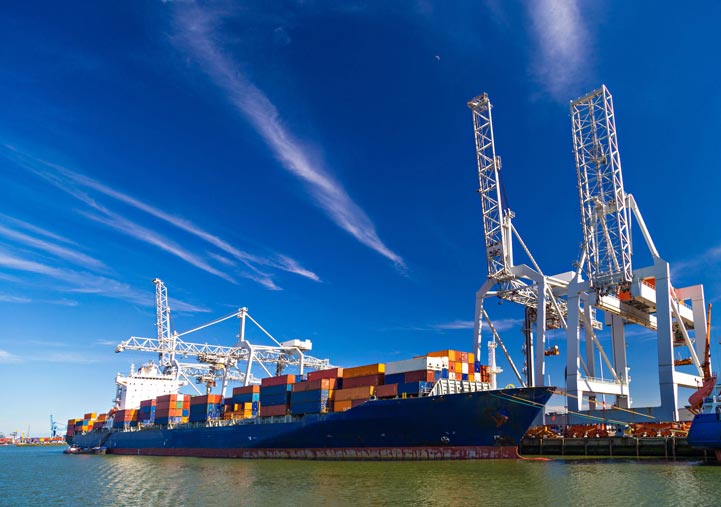
The current capacity of already established container ports is a key consideration for pan-European investors, with Rotterdam, Antwerp and Hamburg still accounting for the highest proportion of the container traffic in Europe. Higher container throughput growth in Antwerp and Rotterdam in recent years has largely been accommodated by improved digital technology and automation.
Railways are an essential means of transporting freight from ports to inland warehouses
Savills European Research
Rotterdam port is now preparing for autonomous vessels by 2025 as IBM and Cisco are creating a digital dashboard to replace the communications between ships and terminal operators. This will reduce vessel waiting times through collecting data around tidal streams, wind strength and visibility. Automated cranes are now hand-picking containers from shipping containers to reduce cost and increase efficiency, with Boston Consulting Group (BCG) reporting that smart port initiatives could double throughput at the port of Hamburg by 2025.
Railways are an essential means of transporting freight from ports to inland warehouses. BCG’s European Railway Performance Index indicates that Germany, France and the Netherlands have the highest quality rail networks in Europe. Likewise, high motorway provision per capita reflects the ease of transport of goods from ports to European distribution centres by road and for these reasons, Rotterdam, Barcelona and Hamburg scored among the higher performers overall.
Read the articles within Spotlight: European Port Logistics - Where Next To Invest? below.