BACK TO SCHOOL
The need to accommodate students has been driven by rapid growth in higher education enrolment worldwide. Student numbers were boosted in the wake of the global financial crisis as a weaker job market meant more people sought to improve their skills. The number of students studying outside their home country has grown even faster. More than four million students did so in 2013, compared to just two million in 2000. Their numbers are forecast to reach eight million by 2025.
The drive to accommodate these students has failed to keep pace so the supply of purpose-built student housing, even in mature markets, remains low. Provision rates range from 24% in the UK to just 6% in Spain and Australia.
A HOTEL FOR STUDENTS
For students, secure, well managed, quality accommodation from a trusted provider is appealing. Providers have sought out cities with high proportions of international students and adapted models from the US and UK to suit local context, laws and customs.
In new markets, hybrid products have helped to spread risk. The Student Hotel, first developed in the Netherlands, offers quality accommodation on a short-term basis, aimed at students but open to everyone. In Germany, private, purpose-built student accommodation comes mainly in the form of studios.
Far from being a ‘noisy nuisance’, students are being used as a tool in some cities to regenerate entire neighbourhoods. The first occupiers at London’s King’s Cross redevelopment were 5,000 university students and staff from Central Saint Martins college, supported by onsite purpose-built accommodation. These students helped to establish a cultural and creative heart by ensuring, from the outset, that the area was busy and vibrant at all times of day for a host of uses.
LOW-COST HUBS
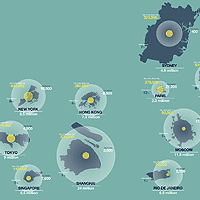
First-tier world cities such as London, Sydney and New York are characterised by high land values and competing demand for the development of other asset classes. It is no coincidence that most purpose-built accommodation to date has focused on the premium market. When combined with tuition fees and living costs, study in these markets can be extremely expensive (see fig. 1).
.jpg)



.png)