Shutterstock
The global cities that we feature are not necessarily the biggest in the world, nor are they the biggest city economies, nor the most powerful cities on the planet (although some are all of these). But they are some of the more famous and high-profile cities within their global regions. High-profile cities attract visitors.This has a knock-on effect by attracting investment as well, including real estate investment. They are high-profile cities able to tell some compelling stories for those trying to read the runes of the global real estate markets.
We have already taken a close look at city populations and densities. The rate of growth in these populations and the amount of land and buildings in a city determine future trends in real estate markets. A big, growing population in a small space will create demand pressures resulting in rent rises, while a shrinking population and large land supply create an entirely different real estate market.
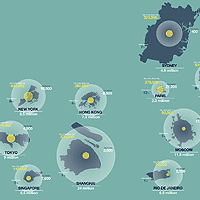
But in all the global cities, there is a significant but uncounted population which rarely features in discussions of land use. It tends to be sidelined in planning discussions which focused on housing and workspace needs. There are around 901 million visitors a year, domestic and overseas across our 12 cities. They spend a total of 1.05 billion nights in varying types of guest accommodation, mainly hotels.
This means that around 2.9 million people every day are competing for accommodation with local residents, creating demand for what we call a ‘Visitor City’. On average, 3% is added to the population of cities by visitors every night. The largest overnight visitor populations are found in New York (0.57 million) and London (0.42 million).
.jpg)
.jpg)
.jpg)

.jpg)
.jpg)
.jpg)

.png)