
The UK Government is focused on home-ownership (see my previous note http://sav.li/4eq) and so it appears likely that most future housing supply will continue to be for market sale. With affordability constraints and new build prices dictated by the market, most developers will inevitably target buyers towards the top end of the market within any particular area.
This approach raises an important question for the housing prospects of all households: can supply that is heavily weighted to higher value new build homes open up the supply of other existing more affordable homes by increasing mobility through the housing market? This is a complex issue and unfortunately data that could answer it is not publicly available for England. However, with the help of my Scotland based colleague Faisal Choudhry, we have begun to look at whether Scottish transactional data can help answer the question.
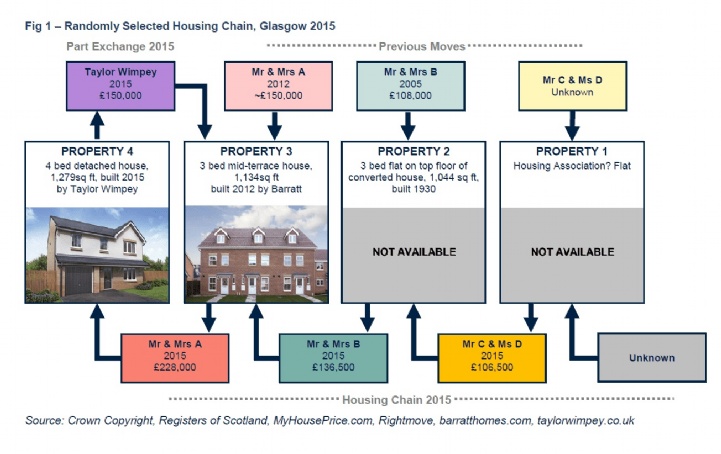
To highlight the potential of the Scottish data, I have selected a recent housing chain at random (I promise) that also fortuitously shows some of the issues in the market. The fairly complex chain in question involves four properties, four households and Taylor Wimpey.
Mr & Mrs A wanted to move house and had found a nearby Taylor Wimpey new build on the market for £228k (Property 4). They had prior experience with new builds having bought their existing mid-terrace home from Barratt in 2012 (Property 3). Their original 2012 purchase price for Property 3 is unclear as it may have been done part-exchange or bought with an equity loan but would have been in the region of £150k.
Unfortunately, Mr & Mrs A did not have a buyer for their existing home (Property 3). To ensure the sale, Taylor Wimpey offered a part-exchange value of £150k for it. Mr & Mrs A then paid the remainder of the full asking price, £228k, for their new home (Property 4). Taylor Wimpey were then left holding Property 3 but they quickly sold it on to Mr & Mrs B for £136.5k. At £13.5k below the price Taylor Wimpey paid for it, that effectively equates to a 6% discount on the asking price of Property 4. The new owners of Property 3, Mr & Mrs B, had been living on the other side of Glasgow in a flat they bought back in 2005 for £108k (Property 2). After advertising it for two months, it was sold to Mr C & Ms D for £106.5k which was 7.6% above the ‘offers over’ asking price. Details for the home (Property 1) that Mr C & Ms D were previously living in are less certain but, from information available, it was most likely a flat owned by a housing association. It is also unclear who moved into Property 1 at the end of the chain.

.png)