
Land is the fundamental ingredient in the construction of new homes. Many of the issues limiting the rate of new home building can be traced back to the pricing and availability of land for residential development.
The availability of development land is constrained by the planning system but also by other factors. Land is generally an appreciating asset and many landowners’ price expectations will be firmly set. Even if planning regulations were eased further, there are limited incentives for landowners to sell at a faster rate than they are currently as that might compromise the price they achieve. That is particularly the case where the land is already generating an income through other uses.
Development land is typically valued using a residual approach with reference to comparable transactions. A developer assesses what new build house price is achievable in that location with reference to prices and sales rates in the second hand market and on nearby comparable new build sites. At a very basic level (assuming no affordable housing, S106 or CIL), multiply that new build house price by the number of homes to be built on the land and you arrive at the gross development value (GDV) of the site. The underlying value of the land is then the GDV less the cost of development and less an appropriate allowance for profit as the formula opposite shows.
When in competition with other developers and assuming discipline on appropriate profit margins, the winning bidder will typically be the one that pushes for a combination of the highest new build price, the highest density (subject to planning) and the lowest build cost (unless one offsets the other). With land typically bought up front, this approach sets the target new build house price in stone. Developers will then only build and sell homes at the rate dictated by market demand for this target new build price. It is through this mechanism that the 10 to 1 ratio between overall housing market transactions and private housing starts is thought to arise.
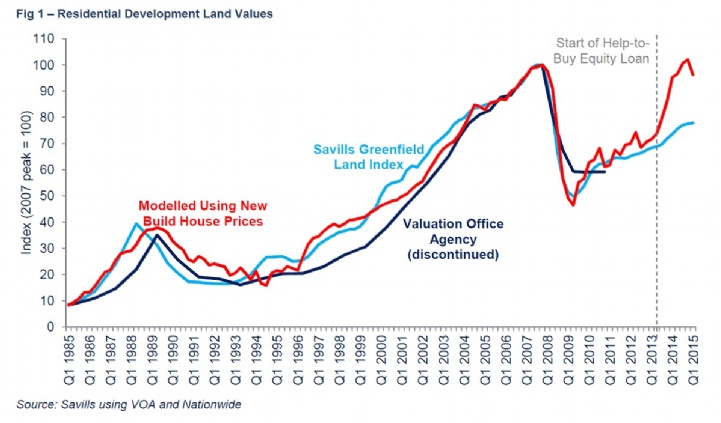
We can demonstrate the link between house prices and land values using a simple model. It uses Nationwide new build house prices as a proxy for GDV and the only input. It is based on an old land buyer’s rule of thumb: land is 1/3rd of GDV. Therefore the modelled land value is 1/3rd of the house price. The volatility in land prices is accounted for by assuming that the remaining 2/3rds (effectively costs and profit) are sticky and do not fall. Therefore land values absorb the full impact of any falls in house price and the full benefit from any rises while house prices are below their previous peak. The model output (red line) does a reasonable job of tracing actual land values up until two years ago.


.jpg "Land values and housebuilding - 1892-1969")
.png)