
Current planning guidance places great importance on household projections as a starting point in identifying the number of new homes needed in a local market. With the 2012-based household projections expected sometime in February it is worthwhile looking at some of the issues that their use presents.
At a national level, the household projections play an obvious and important role in identifying the total amount of new housing supply that should be delivered. The current 2011-interim projections indicate around 220,000 new households forming every year in England. Work by Alan Holmans (2013) extends the projections out to 2031 but also recognises our increased consumption of housing and so the need to build additional dwellings that cater for second homes and vacant dwellings. This process raises the annual increase in households to 243,000 which is unsurprisingly similar to the previous 2008-based projections. This level of housing demand equates to roughly a one percent increase in dwelling stock each year.
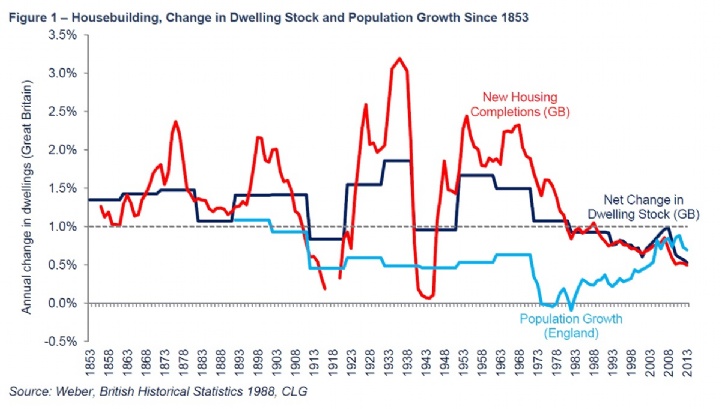
Household projections are heavily based on population projections. As such they are highly dependent on the assumptions contained within the population projections. Perhaps the biggest unknowns within the population projections are the future trends in migration. Therefore any change in the attractiveness of this country as a place to live, work and study could substantially impact on the underling population projections (see chart opposite) and hence the household projections. Current planning guidance identifies households projections as only the starting point for estimating housing need and it is worth repeating the footnote that is found on the CLG’s 2011 household projections spreadsheet:
“They are not an assessment of housing need or do not take account of future policies, they are an indication of the likely increase in households given the continuation of recent demographic trends”
Given the continuation of recent demographic trends, it is also worth noting that they make minimal compensation for the massive historic under-supply of new homes. As the chart below shows, the net change in dwelling stock rarely fell below 1% of stock prior to 1980 but in recent years it has been consistently below 1%. Housing stock has actually increased at or above the rate of new housebuilding thanks to the more intensive use of existing dwellings. Houses converted into flats, empty properties brought back into use and beds-in-sheds have all helped to house a growing population in the face of low new build delivery. Looking ahead we should recognise the need for homes not just to meet demographic trends but also to meet past under-supply, future economic growth and the increased consumption of housing.


.png)