
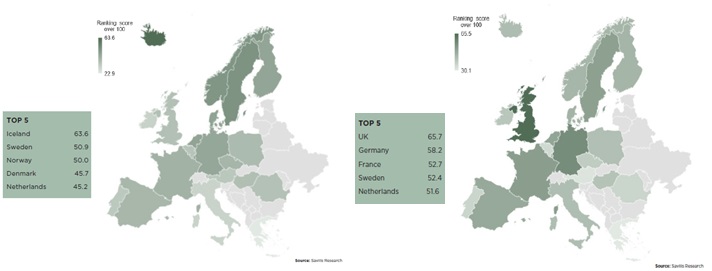
Iceland, Sweden and Norway show top potential for hyperscale and cloud-scale data centre investment, followed closely by Denmark and the Netherlands according to research from Savills.
The report’s benchmark showed that, availability of land, large production of comparatively cheap green energy and strong connectivity provide the potential for economies of scale targeted for hyperscale and cloud-scale data centres operators. Cooler temperatures also favoured countries further to the North of the continent.
With the number of connected devices growing massively, Savills also looked into the potential for development and investment into traditional and cloud data centres, which tend to perform lighter and more diverse tasks, including data streaming which cannot tolerate latency.
UK, France, Germany, Sweden and the Netherlands are the best-graded countries. The countries scored well notably thanks to large data consumer pool, higher population and companies density, higher internet penetration rate, stronger cloud use adoption and solid network of infrastructures.
Lydia Brissy, Director in the European Research Division, commented: “As societies across Europe become more and more connected, especially this year with web traffic growth raging form 35% to 90% within the EMEA region, it is little surprise that the number of hyperscale data centres worldwide has more than doubled between 2015 and Q2 2020 from 259 to 541 according to Cisco Systems.
“As a result of Covid-19, we have seen first-hand the importance of continued network investment, and the exponential increase in companies moving solely to remote working has proved just how fundamental the sector is to keeping the working world afloat. Cloud infrastructures were paramount in enabling governments and healthcare associations to respond quickly to the crisis and remain so as we figure out a new normal.”
Datacentres, a growing asset class
Whilst COVID-19 has brought data centres in the spotlight this year, investors interest for the sector has been growing over the past five years. The fundamentals of the sectors are strong and solid with a flourishing demand set to grow dramatically in the next five years. As data centre migration is a highly complex process, tenants usually occupy the premise for a long period, generally for approximately 10+ years. Hence, the sector offers a long-term income stream and security.
In terms of who is investing, non-specialist private institutions have slowly entered the data centre investment market, including general REITs (Schroder European REIT), investment managers (Catella APAM), institutional investors (AXA) and more recently Sovereign wealth funds (GIC, PFA) and infrastructure funds (Brookfield Infrastructure Partners, EQT Infrastructure) .
Marcus de Minckwitz, Director, Regional Investment Advisory, EMEA, commented: “2020 has marked a clear step towards improved liquidly for the data centre asset class. Investment activity within the sector, which has historically been fuelled by new development activity and M&A, is evolving and we expect to see a more liquid market over the coming years. Returns are currently very attractive when compared to other asset types and there is a very exciting growth story, which is leading to ever increasing levels of interest from investors and developers.”
*The benchmark, draws on 25 indicators gathered into seven categories: security, natural resources & energy supply, broadband infrastructure, costs induced, demand & existing supply, ICT human resources and data centre capital market and covers 21 countries across Europe.